*English version below
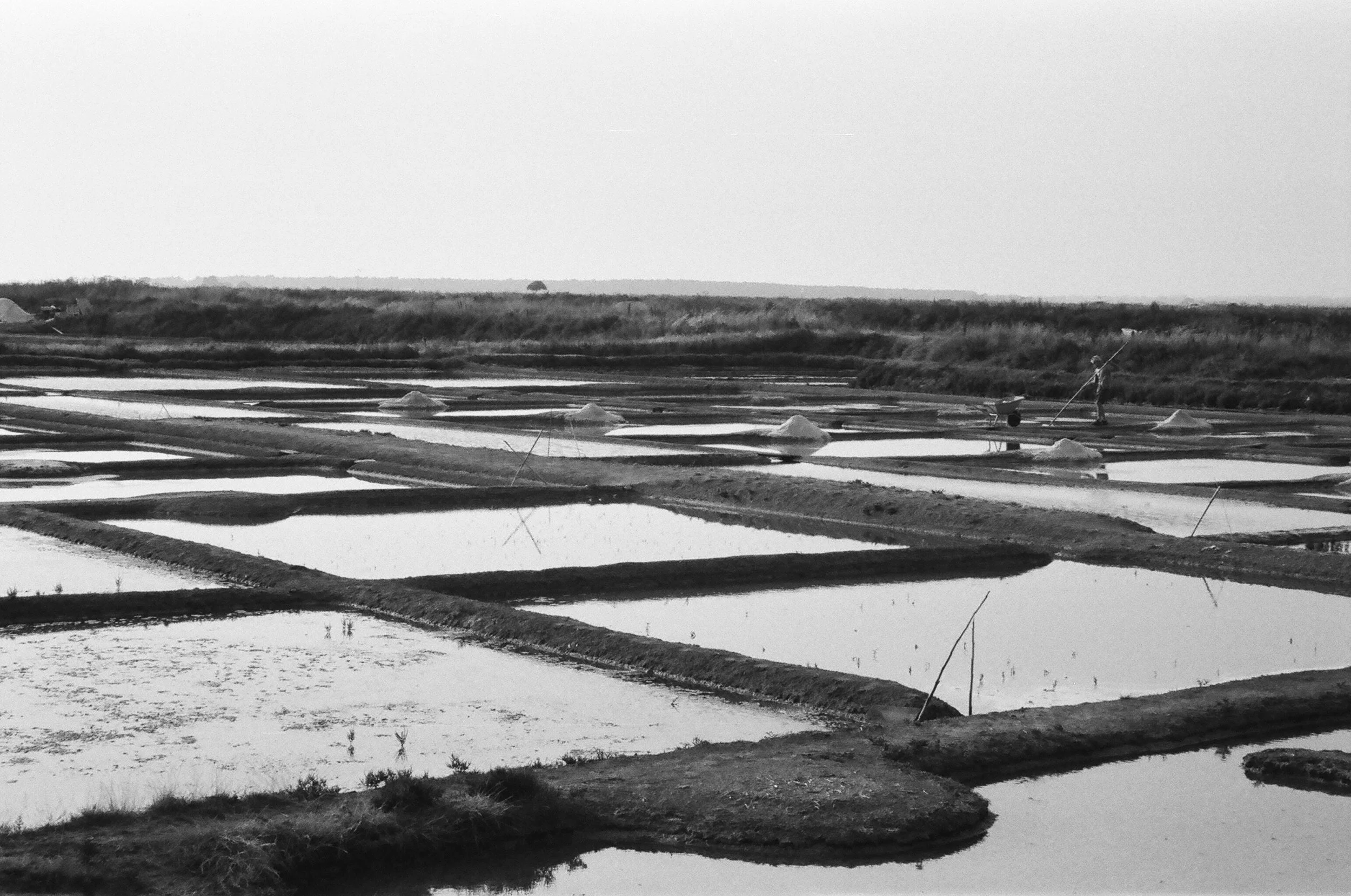
Salinas de Guérande, Bretagne, Francia, 2025
Sobre el Cuidado y el Otro Paisaje
Pensamientos entre viajes.
Un viaje a las salinas de Guérande en Francia me devolvió a Venezuela, dos lugares aparentemente distintos, que en este caso, mi mente une a través de un paisaje:
los humedales costeros.
Esta vasta y húmeda salina francesa me hizo pensar en la palabra cuidar, o también en la ausencia de ello. Cuidar o atender, es una acción menuda y repetida: revisar el viento antes de recoger la sal, sostener un dique, utilizar el las para delicadamente empujar la sal durante horas bajo el sol. En las salinas de Guérande, esa repetición diaria, hecha por manos que llevan más de mil años haciendo lo mismo, no es un gesto aparte del paisaje, es el paisaje mismo. La ecología ahí no sobrevive a pesar del trabajo humano, sino a través de él: el paludier no usa la marisma, la sostiene, y así se sostiene a sí mismo.
Paisajes similares existen en Venezuela, como la salina de Araya, aunque ahí esa relación de cuidado nunca fue plenamente reconocida como tal, atrapada entre un marco cultural que identifica el paisaje con la belleza y uno económico que lo identifica con el recurso. Entre ambos, la posibilidad de habitarlo, de cuidarlo, de conocerlo de otra forma, fue suprimida. Es apenas uno de tantos paisajes venezolanos que no caben ni en la postal ni en la lógica del recurso: paisajes que no se admiran ni se explotan, simplemente se ignoran.
Pienso también en mi propia experiencia con estos paisajes, en los tantos viajes a Falcón por carretera, donde, entre no poder dormir por la incomodidad del cinturón de seguridad y no poder leer más de media página sin marearme, terminaba mirando por la ventana, a la espera de ver aquellos paisajes y momentos del trayecto que me sabía de memoria y me indican cuánto faltaba de camino. Recuerdo claramente las grandes palmeras que escondían la Hacienda Santa Teresa desde la Panamericana, el lago de Valencia, y después de mucho rodar, una fina y larguísima carretera enmarcada por palmas que a aquella edad me parecía que tocaban el cielo, contar bicicletas una a una atravesando Tucacas, y ya llegando a nuestro destino girar a la derecha y atravesar la larga carretera que llega a Chichiriviche con la parada fija para ver los Flamencos en la laguna de Cuare. Sin embargo, el paisaje quizás más intrigante para mí a aquella edad era el laberinto metálico de la Refinería El Palito, un mar de tuberías, de cilindros de concreto, y esas altas chimeneas que soplaban fuego, cuyas llamaradas podía medir entre mis dedos en la distancia. Una máquina misteriosa, distante, inaccesible, lugar y no-lugar; que encarna lo que Smithson llama lo opuesto a la "ruina romántica", un complejo de edificaciones y estructuras que nacen siendo ruinas, inclusive antes de terminar de construirse.
Ahora lo que más me atrae no es la estructura sino el suelo en el cual se encuentra, el espacio entre los componentes de aquel monumento colosal. Justo debajo de nuestros pies, en ese terreno ciertamente ajeno, yace otro paisaje, uno inerte, quizás más abstracto, inclusive más potente, que no podemos observar o admirar en nuestra cotidianidad, cuyo valor sólo conoce términos económicos o políticos. ¿Cómo podemos establecer una relación con ese paisaje mineral , de donde se extrae el tan preciado recurso: petróleo, hierro, acero, oro; impulsada por el cuidado? ¿Cómo hacemos del verbo progresar sinónimo de cuidar?
Robin Winogrond, arquitecta paisajista, plantea que sobre las capas natural y cultural de un paisaje existe una tercera, la del imaginario: hecha de fantasía, memoria y anhelo, además de la experiencia del cuerpo, y es esa capa la que finalmente decide cómo un lugar nos habla y cómo nosotros le hablamos a él. Pienso en esos paisajes que viven en mí, o que seguro viven en muchas otras personas, no solo como recurso ni como belleza, sino como memoria de un trayecto, como imaginario de una infancia, de una vida.
Y pienso que es justo ahí, en esa capa, donde el cuidado podría encontrar su lugar frente al paisaje mineral, el paisaje ignorado, el paisaje porque reimaginar un lugar desde la memoria es empezar a tratarlo con delicadeza, y ese suelo deja, poco a poco, de sentirse ajeno.
Bibliografía
Discover Guérande. (s.f.). Découvrez Guérande. NAC Inc. https://www.ecnac.jp/NAC/en/NAC_Guerande.html
Real Academia Española. (s.f.). Cuidar. En Diccionario de la lengua española. Recuperado de https://dle.rae.es/cuidar
Shafaieh, C. (2020, 15 de enero). Fantasy, Memory, & Longing: Robin Winogrond leads designers on a search for the poetic in banal landscapes. Harvard Graduate School of Design. https://www.gsd.harvard.edu/2020/01/fantasy-memory-longing-robin-winogrond-leads-designers-on-a-search-for-the-poetic-in-banal-landscapes/
Smithson, R. (1996). A tour of the monuments of Passaic, New Jersey. En J. Flam (Ed.), Robert Smithson: The collected writings (pp. 68–74). University of California Press.
On Care and the Other Landscape
Thoughts between travels.
A trip to the salt marshes of Guérande in France brought me back to Venezuela: two seemingly distinct places that, in this case, my mind joins through a single landscape, coastal wetlands.
This vast, damp French salina made me think about the word to care, and also about its absence. To care, to tend, is a small and repeated act: checking the wind before gathering the salt, holding a dike in place, using the las to delicately push the salt for hours under the sun. In the salt marshes of Guérande, that daily repetition, carried out by hands that have done the same thing for over a thousand years, is not a gesture apart from the landscape, it is the landscape. The ecology there doesn't survive despite human labor, but through it: the paludier doesn't use the marsh, he sustains it, and in sustaining it, he sustains himself.
Similar landscapes exist in Venezuela, like the Araya salt flats, though there that relationship of care was never fully recognized as such, caught between a cultural framework that equates landscape with beauty and an economic one that equates it with resource. Between the two, the possibility of inhabiting it, of caring for it, of knowing it differently, was suppressed. It's just one of so many Venezuelan landscapes that fit neither the postcard nor the logic of the resource: landscapes that are neither admired nor exploited, simply ignored.
I also think about my own experience with these landscapes, on the many road trips to Falcón, where, between not being able to sleep because of the discomfort of the seatbelt and not being able to read more than half a page without getting carsick, I would end up staring out the window, waiting for those landscapes and moments of the journey I knew by heart, the ones that told me how much farther we had to go. I clearly remember the tall palm trees that hid the Hacienda Santa Teresa from view along the Panamericana, and later a long, narrow road framed by palms that at that age seemed to touch the sky, counting the bicycles once in Tucacas, and, nearing our destination, turning right onto the long road that leads to Chichiriviche, with the obligatory stop to see the flamingos at the Cuare lagoon. But the landscape that perhaps intrigued me most at that age was the metallic labyrinth of the El Palito Refinery, a sea of pipes, concrete cylinders, and tall chimneys breathing fire, their flares small enough to measure between my fingers from a distance. A mysterious machine, a place and a non-place, one that embodies what Smithson called the opposite of the "romantic ruin," a complex of buildings and structures born as ruins, even before they finish being built.
Now what draws me most is not the structure itself but the ground it sits on, the space between the components of that colossal monument. Right beneath our feet, in that certainly foreign ground, lies another landscape, inert, perhaps more abstract, even more powerful, one we can't observe or admire in our daily lives, whose value is known only in economic or political terms. How can we build a relationship with that mineral landscape, the one from which we extract such prized resources: oil, iron, steel, gold, driven by care? How do we make the verb to progress synonymous with to care?
Robin Winogrond, a landscape architect, suggests that above a landscape's natural and cultural layers lies a third one: the layer of the imaginary, made of fantasy, memory, and longing, along with bodily experience, and it is this layer that ultimately decides how a place speaks to us, and how we speak back to it. I think of those landscapes that live in me, or that could live in someone else, not only as resource or as beauty, but as the memory of a journey, as the imaginary of childhood or of a life lived.
And I think that it's precisely there, in that layer, where care might find its place before the mineral landscape, because reimagining a place through memory is the beginning of treating it with tenderness, and that ground, little by little, stops feeling foreign.
Bibliography
Discover Guérande. (n.d.). Découvrez Guérande. NAC Inc. https://www.ecnac.jp/NAC/en/NAC_Guerande.html
Real Academia Española. (n.d.). Cuidar. In Diccionario de la lengua española. Retrieved from https://dle.rae.es/cuidar
Shafaieh, C. (2020, January 15). Fantasy, Memory, & Longing: Robin Winogrond leads designers on a search for the poetic in banal landscapes. Harvard Graduate School of Design. https://www.gsd.harvard.edu/2020/01/fantasy-memory-longing-robin-winogrond-leads-designers-on-a-search-for-the-poetic-in-banal-landscapes/
Smithson, R. (1996). A tour of the monuments of Passaic, New Jersey. In J. Flam (Ed.), Robert Smithson: The collected writings (pp. 68–74). University of California Press.