*English version below
Este ensayo se basa en la investigación que desarrollé como parte de mi tesis del Máster Especializado en Arquitectura y Escenografía en la École Nationale Supérieure d'Architecture de Paris-Belleville, 2026.
Escenografías vividas
Hogar, aquí o allá, una práctica de recomposición.
He estado pensando en el hogar.
En los hogares del pasado, dispersos a través de los recuerdos.
En nuevos hogares compuestos de vidas presentes, pasadas y futuras.
No me refiero al espacio construido, sino a la manera en que lo habitamos.
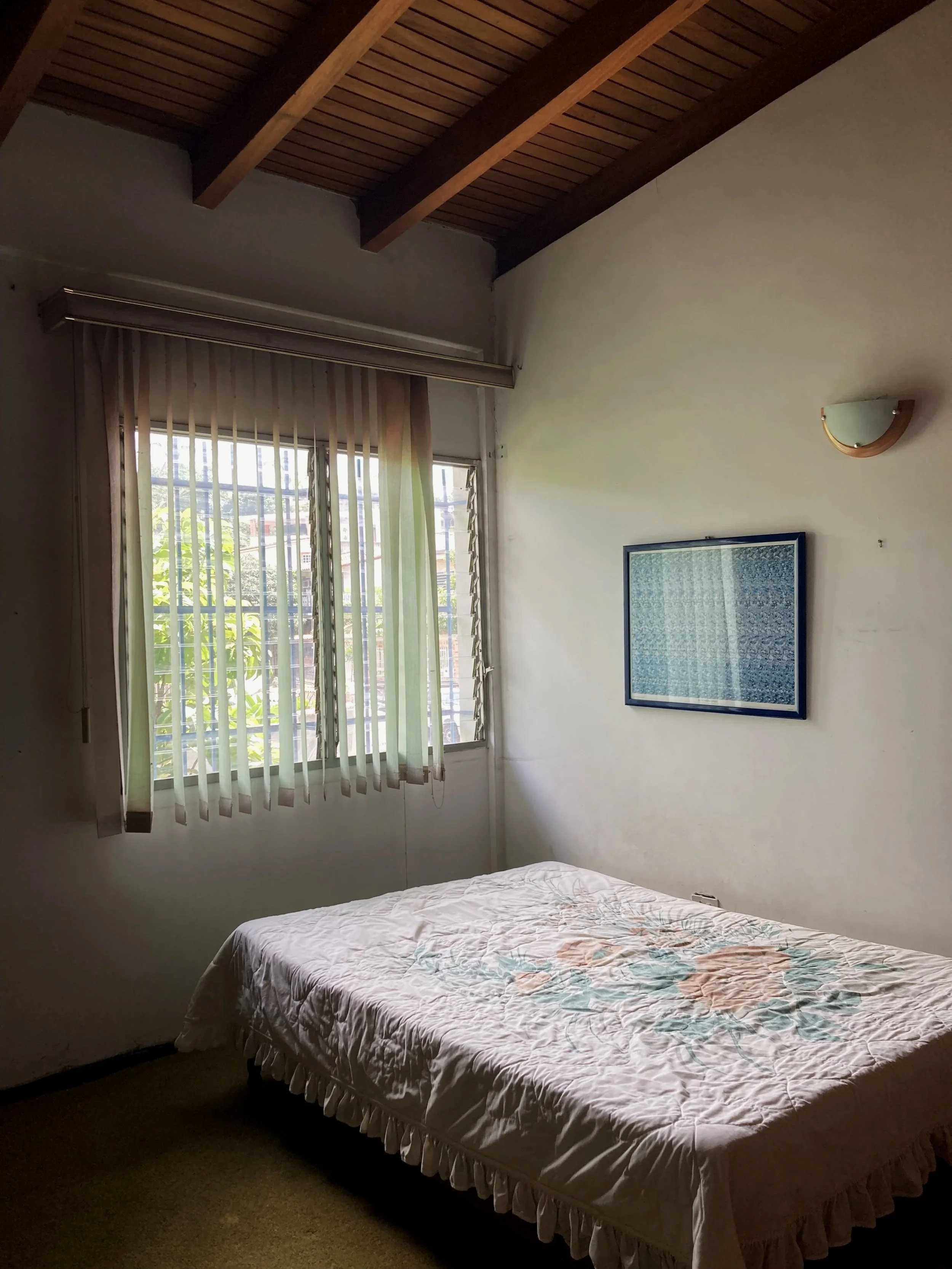
Las rutinas, los objetos, los movimientos, los desplazamientos, los cambios de disposición en relación con una secuencia de espacios. Una pequeña entrada que se abre a una sala de estar, un pasillo estrecho que conduce a un dormitorio con una ventana que da a la calle principal, donde se escuchan pasar los coches.
Me interesa en particular el hogar que se dejó atrás, quizás de manera temporal, pero que ya no forma parte de un presente constante, más allá de los recuerdos. Quizás un hogar que ya no existe porque ya no lo habitamos, pero que el cuerpo todavía recuerda y que busca, de alguna manera, recomponer.
El gesto preciso que la mano aprende para girar y abrir un pomo terco, el lugar donde se depositan las llaves casi sin pensarlo al entrar, ese cuadro que vemos colgado en la pared, posiblemente pintado por un familiar que con los años decidió dedicarse a la pintura, una selección de fotografías enmarcadas dispuestas sobre el aparador, la distancia entre la silla y la ventana donde por las tardes se toma un café, el mueble cuya única función es exhibir una colección de objetos, meticulosamente seleccionados, que de una u otra manera nos representan, que hacemos nuestros, que acogemos. El cuerpo y su entorno desarrollan una relación íntima que, con el tiempo, se convierte en instinto. El entorno se va conformando con el tiempo, estructurado por el hábito... y nosotros también.
Pero habitar no es solo un acto corporal. El hogar existe, ante todo, en el imaginario de cada persona. No es solo una estructura física, sino una construcción interna moldeada por la historia personal, la cultura, la memoria; por lo social y lo económico. El espacio habitado, con sus rutinas, sus objetos, sus disposiciones, es la exteriorización de ese diálogo, muchas veces silencioso, entre lo que somos y lo que quisiéramos ser. El hogar es, en este sentido, una extensión del yo: provisional, en negociación continua, siempre en proceso de transformación.
Clare Cooper Marcus, en su libro House as a Mirror of Self, sostiene que el hogar rara vez es el resultado de una decisión consciente y deliberada. Sus cualidades espaciales se depositan poco a poco, a través de hábitos repetidos y ajustes casi imperceptibles que, precisamente por su carácter cotidiano, escapan a la reflexión. Sin embargo, esa aparente neutralidad es engañosa: el orden o desorden de una habitación, la apertura de un espacio o su sensación de encierro, revelan aspectos de la vida interior que difícilmente podrían expresarse de otra manera. El espacio doméstico se convierte, según la autora, en una especie de autorretrato involuntario.
En este sentido, los objetos que habitamos, y que nos habitan, no son meros elementos decorativos o funcionales. Participan activamente en la construcción del yo. Mihaly Csikszentmihalyi lo describe con precisión cuando habla de una ecología de signos, una red de cosas y disposiciones a través de la cual la identidad toma forma, se sostiene y se comunica, tanto hacia afuera como hacia adentro.
Esta relación, sin embargo, no es estable. Construir un hogar es un acto provisional y reversible: clasificamos, descartamos e instalamos objetos que se ajustan a nuestra realidad del momento. Como señala Georges Perec en Espèces d'espaces, el espacio nunca se posee de manera definitiva, sino que se remarca y renegocia continuamente.
Esta condición se agudiza especialmente cuando se habita un espacio nuevo, donde el cuerpo llega cargando con todos los espacios anteriores. Gaston Bachelard sostiene que los lugares habitados en el pasado no desaparecen: persisten en el cuerpo como una memoria dimensional, hecha de umbrales, proporciones, ángulos de luz. Habitar es siempre una superposición. Habitar un nuevo hogar intensifica esa condición hasta hacerla perceptible: el nuevo espacio debe negociarse frente a capas de memoria espacial que no le pertenecen. Y es en ese desplazamiento donde comienza algo distinto: una selección, un proceso de toma de decisiones. Qué objetos tienen lugar, cómo se disponen, qué permanece visible y qué se guarda.
Un proceso de instalación que es, inevitablemente, un proceso de narración. Elegimos, incluso sin saberlo, cómo queremos ser leídos, cómo queremos ser vistos.
Y es precisamente desde esta perspectiva que la composición, y recomposición, del hogar se revela como una práctica escenográfica. La vida interior toma forma visible, espacial: los objetos y su disposición cuentan una historia que el lenguaje no siempre logra decir.
Y en ese proceso de desplazamiento, de hacer del espacio desconocido un hogar, nos reconstruimos a nosotros mismos.
Bibliografía
Bachelard, Gaston. La poétique de l'espace. París: Presses Universitaires de France, 1957.
Cooper Marcus, Clare. House as a Mirror of Self: Exploring the Deeper Meaning of Home. Berkeley: Conari Press, 1995.
Csikszentmihalyi, Mihaly, y Eugene Rochberg-Halton. The Meaning of Things: Domestic Symbols and the Self. Cambridge: Cambridge University Press, 1981.
Goffman, Erving. The Presentation of Self in Everyday Life. Nueva York: Doubleday, 1959.
Perec, Georges. Espèces d'espaces. París: Galilée, 1974
This essay draws on research I developed as part of my Specialised Master's thesis in Architecture and Scenography at École Nationale Supérieure d'Architecture de Paris-Belleville, 2026.
Lived scenographies
Home, here or there, a practice of recomposition.
I have been thinking about home.
About the homes of the past, scattered throughout memories.
About new homes composed of present, past, and future lives.
I am not referring to the built space, but to the way we inhabit it.
The routines, the objects, the movements, the displacements, the shifts in arrangement in relation to a sequence of spaces. A small entrance that opens into a living room, a narrow hallway that leads to a bedroom with a window facing the main street, where you can hear the cars go by.
I am interested in particular in the home that was left behind, perhaps temporarily, but that is no longer part of a constant present, beyond memories. Perhaps a home that no longer exists because we no longer inhabit it, but that the body still remembers and that seeks, somehow, to recompose.
The precise gesture the hand learns how to turn and open a stubborn doorknob, the place where the keys are deposited almost without thinking upon entering, that painting we see hanging on the wall, possibly done by a relative who over the years decided to dedicate themselves to painting, a selection of framed photographs arranged on the sideboard, the distance between the chair and the window where in the afternoon one drinks coffee, the piece of furniture whose only function is to display a collection of objects, meticulously selected, that in one way or another represent us, we make them ours, we welcome them in. The body and its surroundings develop an intimate relationship that, with time, becomes instinct. The environment takes shape over time, structured by habit…and so do we.
But inhabiting is not only a bodily act. Home exists, first and foremost, in the imaginary of each person. It is not only a physical structure but an internal construction shaped by personal history, culture, memory; by the social and the economic. The inhabited space, with its routines, its objects, its arrangements, is the externalization of that dialogue, often silent, between what we are and what we would like to be. Home is, in this sense, an extension of the self: provisional, in continuous negotiation, always in the process of transforming.
Clare Cooper Marcus, in her book House as a Mirror of Self, argues that home is rarely the result of a conscious and deliberate decision. Its spatial qualities are deposited little by little, through repeated habits and almost imperceptible adjustments that, precisely because of their everyday nature, escape reflection. Yet that apparent neutrality is deceptive: the order or disorder of a room, the openness of a space or its sense of enclosure, reveal aspects of the interior life that could hardly be expressed in any other way. The domestic space becomes, according to the author, a kind of involuntary self-portrait.
In this sense, the objects we inhabit, and that inhabit us, are not merely decorative or functional elements. They actively participate in the construction of the self. Mihaly Csikszentmihalyi describes this with precision when he speaks of an ecology of signs, a web of things and arrangements through which identity takes shape, sustains itself, and communicates itself, both outward and inward.
This relationship, however, is not stable. Building a home is a provisional and reversible act: we sort, discard, and install objects that adjust to our reality of the moment. As Georges Perec notes in Espèces d'espaces, space is never definitively possessed, but continuously remarked and renegotiated.
This condition becomes especially acute when one inhabits a new space, where the body arrives carrying all previous spaces. Gaston Bachelard argues that the places inhabited in the past do not disappear: they persist in the body as a dimensional memory, made of thresholds, proportions, angles of light. Inhabiting is always a superimposition. Inhabiting a new home intensifies that condition until it becomes perceptible: the new space must be negotiated against layers of spatial memory that do not belong to it. And it is in this displacement that something different begins: a selection, a decision-making process. Which objects have a place, how they are arranged, what remains visible and what is put away.
A process of installation that is, inevitably, a process of narration. We choose, even when we may not know it, how we want to be read, how we want to be seen.
And it is precisely from this perspective that the composition - and recomposition - of home reveals itself as a scenographic practice. The interior life takes visible, spatial form: the objects and their arrangement tell a story that language does not always manage to say.
And in that process of displacement, of making home out of an unfamiliar space, we reconstruct ourselves.
Bibliography
Bachelard, Gaston. La poétique de l'espace. Paris: Presses Universitaires de France, 1957.
Cooper Marcus, Clare. House as a Mirror of Self: Exploring the Deeper Meaning of Home. Berkeley: Conari Press, 1995.
Csikszentmihalyi, Mihaly, and Eugene Rochberg-Halton. The Meaning of Things: Domestic Symbols and the Self. Cambridge: Cambridge University Press, 1981.
Goffman, Erving. The Presentation of Self in Everyday Life. New York: Doubleday, 1959.
Perec, Georges. Espèces d'espaces. Paris: Galilée, 1974.